

A&M Dental Group · Balcatta
Clear Aligners in Balcatta
Considering treatment for crowded teeth, gaps or an uneven smile? Clear aligners are one option for moving teeth. At A&M Dental Group, we assess your teeth, gums and bite and discuss whether aligners may suit your needs.
Understand the process, daily commitment and alternatives before deciding on treatment.
Always follow the directions for use.
THE BASICS
What are clear aligners?
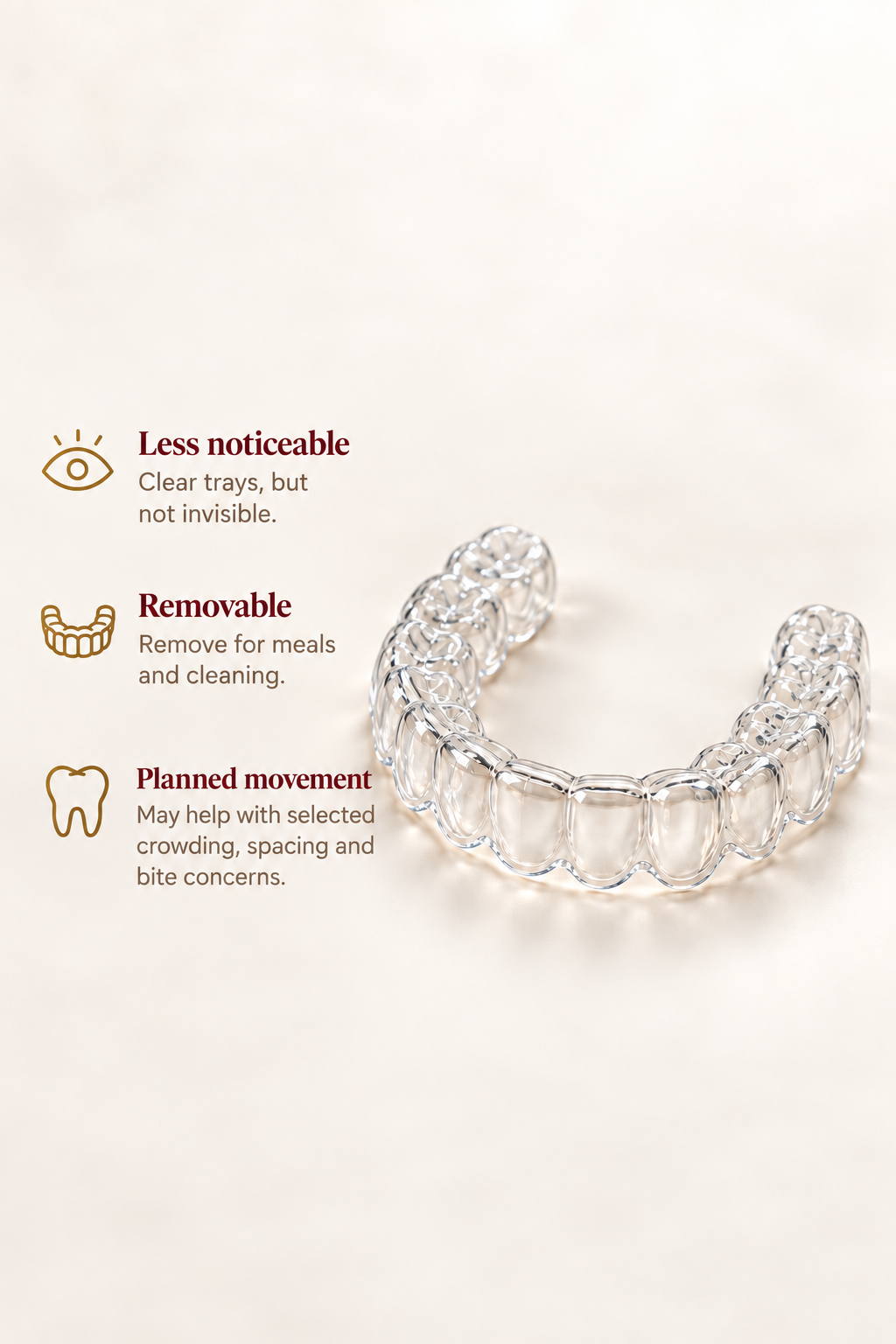
Clear aligners are thin, removable trays made to fit your teeth. A sequence of trays applies planned pressure to move teeth over time. They are less noticeable than metal brackets, but they are not invisible.
Aligners are removed for meals and cleaning and worn for the rest of the prescribed time. Treatment requires assessment and ongoing supervision; it is more than ordering a set of trays.
Suitability depends on the movements needed, your oral health and your ability to follow the plan. Braces or referral to an orthodontist may be more appropriate.
SUITABILITY FIRST
What concerns may clear aligners address?
An assessment can help identify whether aligners are appropriate for your particular concern. Not all tooth or jaw movements can be managed in the same way.
01 / CROWDING
Crowded or overlapping teeth
Some crowded teeth can be considered for aligner treatment. Available space and the movement required affect the options.
02 / SPACING
Gaps between teeth
Some spaces may be managed with aligners. Your dentist first considers the cause of the gap and surrounding teeth and gums.
03 / ALIGNMENT
Rotated or uneven teeth
Selected alignment concerns may be suitable. The position and shape of individual teeth can affect the treatment plan.
04 / BITE
Some bite concerns
How the upper and lower teeth meet needs careful assessment. More complex bite or jaw concerns may require other treatment or specialist referral.
Active decay or gum disease may need care before teeth are moved. Age, developing teeth, previous dental work and medical history also matter.
YOUR FIRST VISIT
What happens at an aligner assessment?
01 · Your concerns
Discuss what you would like to understand, any previous orthodontic treatment and your medical and dental history.
02 · Teeth, gums and bite
Examine your oral health and how your teeth meet, rather than assessing appearance alone.
03 · Records if needed
Photographs, an intraoral scan and X-rays may be recommended according to clinical need.
04 · Discuss options
Explain suitability, alternatives, limitations, risks and the commitment involved before you choose whether to proceed.
A STAGED PROCESS
Clear aligner treatment at A&M
Your plan is individual. The sequence, number of trays and appointment schedule can change according to your needs and progress.
01 / Assess
Examination and suitability
Identify the concern and any dental care needed first. Consider aligners, other options or referral.
02 / Plan
Digital records and planning
Our intraoral scanner can record visible tooth surfaces and the bite. Separate imaging may be needed to assess roots and supporting structures.
03 / Fit
Aligner fitting and instructions
If treatment is suitable and agreed, check the trays and explain insertion, removal, daily wear and care.
04/ Review
Scheduled progress checks
Review fit, tooth movement and oral health. Change trays only on the schedule your clinician provides.
05/ Adjust
Further planning if needed
Additional scans or aligners may be needed if movement differs from the plan. Other options may be discussed.
06/ Retain
Retainers and ongoing care
Discuss retention after active treatment. Teeth can move again, so follow the prescribed retainer and review schedule.
EVERYDAY COMMITMENT
Living with clear aligners
01
Follow your wear schedule
Many systems require around 20–22 hours daily. Follow the instructions for your prescribed system; extra time out can affect progress.
02
Remove for meals
Remove trays to eat and for drinks other than water. Ask your clinician about your product instructions.
03
Keep teeth and trays clean
Brush and clean between teeth. Clean trays as instructed and avoid hot water that may distort them.
04
Attend your reviews
Report a lost or cracked tray, poor fit, a detached attachment or persistent pain. Do not skip ahead without advice.
Always follow the directions for use.
Related care: Preventive dentistry · Urgent dental concerns
CHOICE MATTERS
Clear aligners and other options
There is no single best option for everyone. Your clinician can explain the approach that fits the tooth movements and your circumstances.
Design
Clear aligners: Clear removable trays; attachments may be visible.
Fixed braces: Brackets and wires attached to teeth; different designs are available.
Suitability
Clear aligners: Depends on the required movements and individual circumstances.
Fixed braces: May be recommended depending on the movements and treatment needs.
Daily Commitment
Clear aligners: Requires consistent prescribed wear and careful tray handling.
Fixed braces: Remains attached; requires cleaning around brackets and care with food.
Daily Commitment
Clear aligners: Retention and ongoing review are needed.
Fixed braces: Retention and ongoing review are needed.
Monitoring without active treatment may also be discussed in some situations. A&M can explain when an orthodontist's assessment is appropriate. This comparison does not imply that A&M provides every type of braces.
INFORMED DECISIONS
Risks, limitations and retainers
Pressure, tenderness, irritation or temporary speech changes can occur. Poor cleaning can contribute to decay and gum problems. Orthodontic tooth movement can also involve root shortening, gum recession or changes to the bite; individual risks need assessment.
Teeth may not move exactly as planned. Additional treatment or a revised approach may be needed, and treatment time can change..
Retainers are part of the plan
Teeth can move after treatment. Retainers help maintain tooth positions when used as prescribed. Discuss long-term wear, cleaning and replacement, and contact the clinic if a retainer breaks or no longer fits.
COMMON QUESTIONS
Clear aligner FAQs
-
That requires an examination of your teeth, gums and bite. The movements needed, oral health and daily wear commitment affect suitability. Some concerns require braces or specialist care.
-
There is no fixed duration for everyone. It depends on the planned movements, tooth response, wear and reviews. Your clinician discusses an estimated schedule after assessment; it may change.
-
No. Trays and attachments may be noticeable. Pressure, tenderness or irritation can occur. Contact the clinic if discomfort persists, becomes severe or the tray does not fit.
-
Follow your clinician’s schedule. Do not assume every tray is changed at the same interval or that online monitoring replaces in-person reviews.
-
A scan records visible surfaces. If a simulation is prepared, it shows planned movement rather than a guaranteed result. Roots and supporting tissues may need separate imaging.
-
Some plans use attachments, elastics or carefully planned enamel reduction between teeth. Your dentist explains any proposed additional steps and seeks consent before proceeding.
-
Some teenagers may be suitable, depending on growth, tooth development and ability to follow instructions. Contact the clinic to discuss age suitability and whether specialist assessment is needed.
-
Contact the clinic for instructions. Do not move to another tray, modify it or stop the plan for an extended period without professional advice.
-
Retention is generally needed after orthodontic treatment. Your clinician explains the type and wear schedule. Tooth positions can change if retainers are not used as advised.
VISIT A&M DENTAL GROUP
Questions about straightening your teeth?
Suite 4, Level 1, 275 Wanneroo Road, Balcatta WA 6021
Call (08) 6285 9007 or book an appointment online.
We welcome enquiries from Balcatta and nearby suburbs, including Stirling, Westminster, Nollamara and Osborne Park.
Treatment needs and outcomes vary. Always follow the directions for use.