

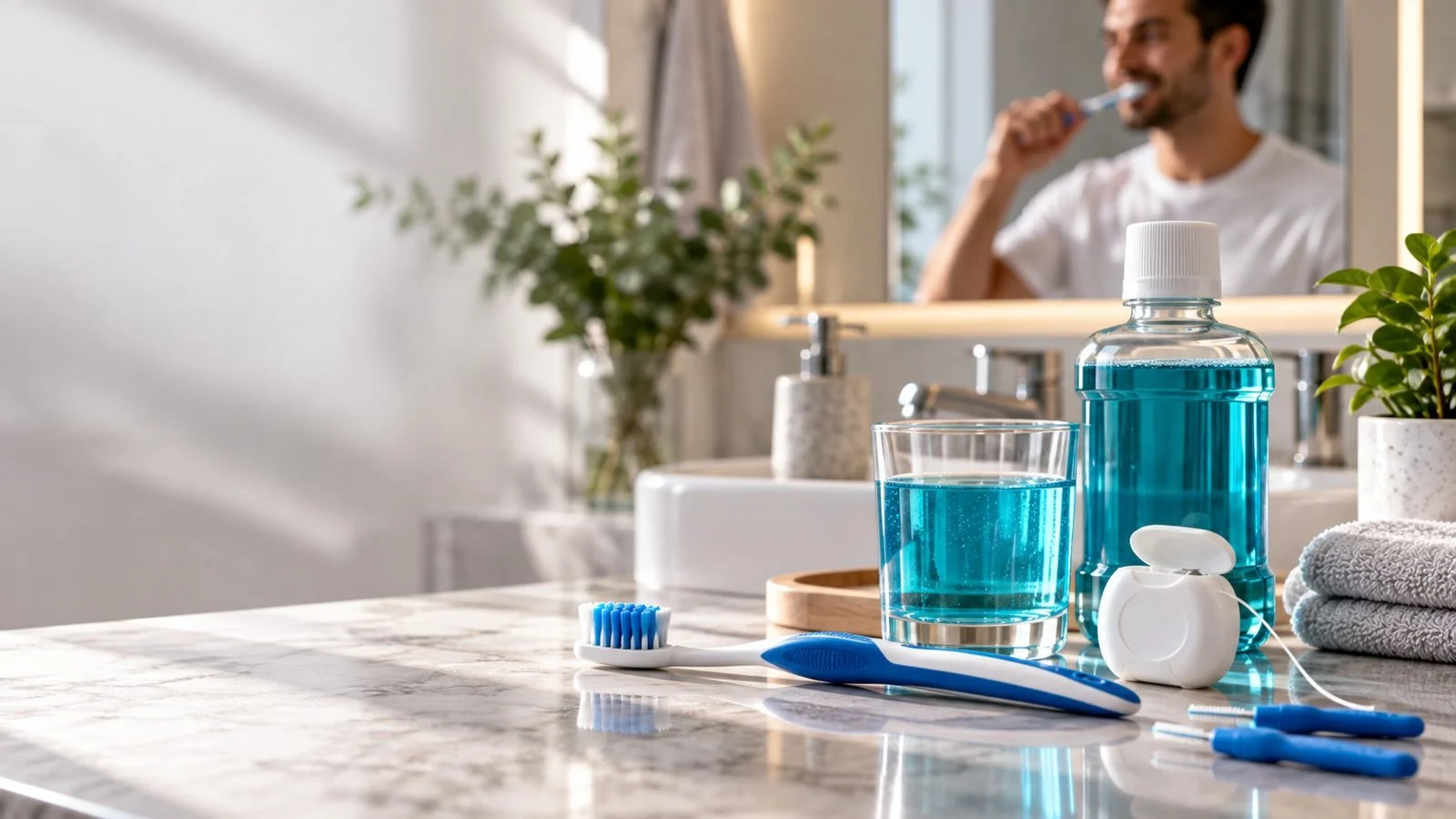
How to Choose and Use Mouthwash
Fluoride, chlorhexidine or alcohol-free: what the evidence actually supports, and where mouthwash fits around brushing and flossing.
This article is general dental information only, not personalised advice. Please speak to your dentist about your own oral health before changing your routine.
Clinically reviewed by Dr Asfiya Anjum, Dentist, A&M Dental Group.
Quick Answer
Used twice a day alongside brushing and flossing, the right mouthwash can meaningfully lower cavity and gum disease risk. A fluoride rinse is the general-purpose choice, chlorhexidine is the short-term option for active gum disease, and alcohol-free formulas suit dry mouth or sensitive gums. Mouthwash is a supporting step, not a substitute for brushing
Dentists are talking about mouthwash again, and this time the evidence has caught up with the advice. [2] For most people it is a genuinely useful addition to a daily routine. But which bottle to reach for, when to use it, and what it can and can't do depends on ingredients that are easy to overlook on a supermarket shelf.
Timing and technique
Rinsing twice daily, ideally morning and night, is the general recommendation for most therapeutic mouthwashes.[2] Technique matters as much as timing: mouthwash is a rinse-and-spit step, used after brushing, not a shortcut around it.
People who are prone to dry mouth or have sensitive gums are often advised to avoid alcohol-containing formulas.[5] The evidence behind that caution is thinner than the advice suggests. A randomised controlled trial published in the Journal of Oral Rehabilitation found no significant short-term worsening of dry mouth (xerostomia) from alcohol-containing rinses.[6] Even so, alcohol can sting already-sensitive gum tissue, and alcohol-free versions appear equally effective with fewer adverse effects, which is why they are still the more comfortable everyday choice for these patients.[5]
Mouthwash and children
Children over the age of six can generally use mouthwash, with a parent supervising.[7] That age threshold isn't arbitrary: fluoride rinses should only be used by someone who can reliably spit rather than swallow, and for most children that reliably happens from around age six.[7]
AT A GLANCE
2X
daily use generally recommended, morning and night
~27%
reduction in decayed, missing or filled tooth surfaces with supervised fluoride rinse use in children/adolescents
6 yrs
general age threshold before which fluoride rinse isn't recommended
35
trials included in the Cochrane review behind that figure
What is actually in the bottle matters
Not all rinses are created equal. Therapeutic mouthwashes carry active ingredients such as fluoride, which strengthens enamel and helps prevent cavities.[3] That isn't marketing language. A Cochrane systematic review of 35 trials found that supervised, regular use of fluoride mouthrinse cut decayed, missing and filled tooth surfaces in children and adolescents by roughly 27 percent, a benefit that held even among children who already used fluoride toothpaste or drank fluoridated water.[3] Fluoride works locally, diffusing into enamel during acid attacks and helping rebuild a crystal structure that resists future decay. [3]
For gum disease, antiseptic mouthwashes do the heavier lifting. Chlorhexidine remains the standard option for controlling plaque and gingivitis, while essential-oil and cetylpyridinium chloride formulas offer gentler alternatives more suited to everyday, long-term use.[4] Chlorhexidine, however, is best reserved for short, defined courses, because prolonged use is linked to tooth staining and other side effects.[4]
A 2023 review in the International Dental Journal makes a related point worth sitting with: the strongest evidence supports mouthwash used adjunctively, alongside mechanical cleaning, and rinses may offer little added value to people who already have healthy gums and low cavity risk.[1] Plaque still has to be physically scrubbed away. No rinse changes that.
Choosing and using mouthwash
The bottom line
The right mouthwash, used consistently and for the right reason, is a genuinely evidence-backed part of an oral care routine.[1][3] Picking the active ingredient that matches your situation, rinsing twice a day, and never letting it replace the toothbrush is the whole strategy. If you're not sure which type suits you, it's a two-minute question for your next check-up.
Common Questions
-
Not always. A 2023 review in the International Dental Journal found that rinses add little extra benefit for people with healthy gums and low cavity risk, because their main job is supporting brushing and flossing, not replacing the physical removal of plaque.
-
No. The evidence reviewed here is consistent on this point: plaque has to be physically scrubbed away, and mouthwash is described as an adjunct, used alongside mechanical cleaning, never instead of it.
-
The evidence is mixed. A randomised controlled trial in the Journal of Oral Rehabilitation found no significant short-term worsening of dry mouth from alcohol-containing rinses, but alcohol can still sting sensitive gum tissue, and alcohol-free versions appear equally effective with fewer adverse effects.
-
Around age six, and only with supervision. Fluoride rinses are only appropriate once a child can reliably spit rather than swallow, which for most children is around that a
-
Fluoride mouthwash strengthens enamel and helps prevent cavities. A Cochrane review of 35 trials found supervised, regular use cut decayed, missing and filled tooth surfaces in children and adolescents by roughly 27 percent. Chlorhexidine works differently, controlling plaque and gum inflammation, and is considered the standard short-term option for gum disease.
-
Chlorhexidine is effective against plaque and gingivitis, but prolonged use is associated with tooth staining and other side effects, so it is generally reserved for short, defined courses rather than everyday long-term use.
References
Brookes ZLS, McCullough M, Kumar P, McGrath C. Mouthwashes: Implications for Practice. International Dental Journal. 2023.
Brookes Z, Bescos R, Witton R, et al. An Update on Mouthwashes: Advice for Dental Practitioners. British Dental Journal. 2025.
Marinho VC, Chong LY, Worthington HV, Walsh T. Fluoride Mouthrinses for Preventing Dental Caries in Children and Adolescents. The Cochrane Database of Systematic Reviews. 2016.
Tartaglia GM, Kumar S, Fornari CD, Corti E, Connelly ST. Mouthwashes in the 21st Century: A Narrative Review About Active Molecules and Effectiveness on the Periodontal Outcomes. Expert Opinion on Drug Delivery. 2017.
Moran JM. Home-use oral hygiene products: mouthrinses. Periodontology 2000. 2008.
Nair R, Chiu SE, Chua YK, et al. Should short-term use of alcohol-containing mouthrinse be avoided for fear of worsening xerostomia? Journal of Oral Rehabilitation. 2018.
Schlueter N, Hellwig E, Geurtsen W, Rupf S. Caries prevention in permanent teeth – basic recommendations of the German S3 guideline. Clinical Oral Investigations. 2026.
NBC News. "Mouthwash in Oral Care: Adjunctive Use Backed by New Evidence." 13 September 2026. Commentary from Dr Matt Messina, The Ohio State University College of Dentistry, and a second US dental clinician quoted in the same piece, aggregated via OpenEvidence.