


Patient Guide ... Preventive Dentistry
-
Patient Guide ... Preventive Dentistry -
Toothache: What Your Tooth Pain May Be Telling You
A practical guide to possible causes of tooth pain, what a dental examination may involve, and the warning signs that need urgent or emergency attention.
This article provides general dental information only. It does not replace an individual assessment. Please speak to your dentist about your symptoms, risks and recommended care.
Clinically reviewed by Dr Asfiya Anjum, Dentist, A&M Dental Group.
Toothache is a symptom, not a diagnosis. The same ache, sharp, dull, throbbing or fleeting, can arise from several different problems inside or around a tooth. This guide explains what different pain patterns may suggest, what an examination usually involves, and when tooth pain needs prompt or emergency attention.
“Toothache is a symptom, not a diagnosis. Sharp, dull, throbbing or intermittent pain can arise from decay, a crack, inflammation inside the tooth, gum disease, an existing restoration or infection. A dental examination is the reliable way to identify the cause. Significant swelling or difficulty breathing or swallowing requires emergency medical care.”
QUICK ANSWER
Why toothache alone cannot tell you what is wrong
A toothache is the nervous system's way of signalling that something is irritating a tooth or the tissues around it. Pain patterns can overlap: a cracked tooth, early decay and inflamed pulp tissue may all cause sharp pain to cold, while an infected tooth and a restoration sitting high on the bite may both hurt when you chew. A careful history and hands-on examination, not the symptom pattern alone, help a dentist determine the likely cause. [4]
Common possible causes of toothache
Several dental conditions can produce tooth pain, and more than one may be present at the same time.
Tooth decay
As decay progresses through the tooth toward the pulp, sensitivity or pain may develop. Untreated dental decay remains common among Australian adults. [1]
Pulp inflammation
Inflammation of the tissue inside the tooth may be reversible or irreversible. It can cause pain triggered by hot, cold or sweet foods, or spontaneous pain that lingers.
Existing restorations and wisdom teeth
A filling or crown that is worn, cracked or slightly high on the bite can cause localised discomfort. Partially erupted or impacted wisdom teeth may also cause pain from pressure, gum inflammation or infection.
Cracked teeth
A crack may cause sharp pain during chewing or when the bite is released. Some cracks are difficult to identify without close clinical inspection and testing. [4]
Gum disease
Inflammation or infection of the gums and supporting bone can cause aching, tenderness or sensitivity, particularly around the root surface. Periodontitis affects a substantial proportion of Australian adults. [1]
Dental infection or abscess
An infection reaching the tissues around the root can cause dull or throbbing pain, pain on pressure, swelling, pus or an unpleasant taste. Spreading infection requires urgent assessment.
What different pain patterns may suggest
Sensitivity to hot or cold
can occur with early decay, exposed dentine, a cracked tooth or inflammation inside the tooth. Pain that lingers after the stimulus is removed may indicate a more significant problem, but testing is needed to establish the cause.
Throbbing, persistent or spontaneous pain
can occur with more advanced inflammation or infection and may accompany swelling.
Pain when biting or chewing
may relate to a crack, a high filling, inflammation near the root tip or gum disease affecting the tooth's support structures.
Pain that comes and goes
may reflect an early or intermittent process. A temporary improvement does not necessarily mean the underlying problem has resolved.
A few numbers worth knowing
“Nearly 1 in 3
Australian adults had at least one tooth surface with untreated decay in the 2017 –18 national study”
“Just over 30%
Australian adults had periodontitis in the same national study”
When should toothache be assessed
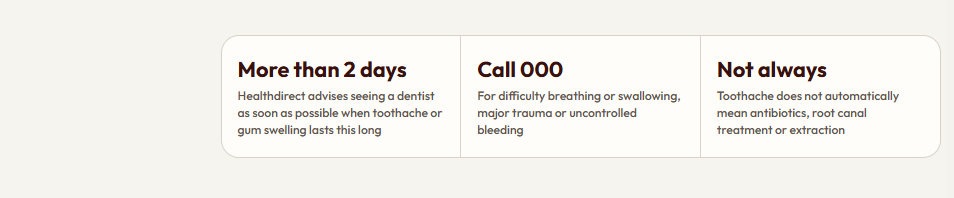
Arrange a dental assessment for new or persistent toothache, even if the pain is mild or comes and goes. Healthdirect advises seeing a dentist as soon as possible when toothache or gum swelling lasts more than two days, does not improve with pain-relief medicine, or occurs with fever, trouble swallowing, pain on biting, a bad taste, or cheek or jaw swelling. [3] Early assessment may preserve a wider range of treatment options, depending on the diagnosis.
When should toothache be assessed
Some symptoms warrant an urgent dental review, while a smaller number require emergency medical attention.[3] [6]
Arrange an urgent dental appointment for
Throbbing pain that is worsening or not settling with simple pain relief
Mild, localised swelling of the gum or face that is not affecting breathing or swallowing
A loose tooth, or a lost filling or crown with ongoing pain
Pus or an unpleasant taste associated with a painful tooth
“11.6% to 16.2%
Increase in reported toothache prevalence between 1994 and 2013 in an Australian time-trend study”
When should toothache be assessed
Arrange a dental assessment for new or persistent toothache, even if the pain is mild or comes and goes. Healthdirect advises seeing a dentist as soon as possible when toothache or gum swelling lasts more than two days, does not improve with pain-relief medicine, or occurs with fever, trouble swallowing, pain on biting, a bad taste, or cheek or jaw swelling. [3] Early assessment may preserve a wider range of treatment options, depending on the diagnosis.
Seek emergency medical care or call 000 for
Significant or spreading swelling of the face, jaw or neck, particularly around the eye
Difficulty breathing or swallowing
High fever, confusion or feeling seriously unwell with dental pain or swelling
Major facial trauma or uncontrolled bleeding from the mouth
Problems with breathing or speaking, swelling around the eye or neck, heavy oral bleeding, or severe swelling of the mouth or tongue require emergency medical care. [3] [6]
What to do while waiting for an appointment
Avoid very hot, cold or hard foods on the affected side, and gently rinse with warm water if this helps. These measures may improve comfort but do not diagnose or resolve the underlying cause.
Ask a pharmacist, GP or dentist which over-the-counter pain-relief options and doses are suitable for you, particularly if you have other medical conditions, allergies, or are pregnant or breastfeeding. Do not start antibiotics without a dentist's or doctor's assessment. Antibiotics are not appropriate for most causes of toothache and do not replace treatment of the underlying dental problem. [5]
Toothache does not automatically mean
“Early decay, gum inflammation, sensitivity or a restoration sitting high on the bite may be managed without root canal treatment. Whether it is needed depends on the condition of the tissue inside the tooth and the diagnosis.”
“Extraction may be one option for a severely damaged or infected tooth, but many painful teeth can be treated and retained. The available options depend on the diagnosis and the tooth’s overall condition.”
“Evidence-based guidance generally reserves antibiotics for infections with signs of spread or systemic involvement, such as fever, facial swelling or malaise. Dental treatment addresses the underlying cause of most tooth pain.[5]”
Toothache FAQs
-
Tooth pain can arise from decay, a crack, inflamed or infected pulp tissue, gum disease, an issue with an existing filling or crown, or a wisdom tooth. An examination is usually needed to identify the specific cause.[4]
-
Pain on biting can be associated with a cracked tooth, a filling sitting slightly high, inflammation near the root tip or other conditions. A dentist needs to examine and test the tooth to distinguish between them.
-
Cold sensitivity can relate to exposed dentine, early decay, a crack or inflammation inside the tooth. Brief sensitivity that resolves quickly is a different clinical clue from pain that lingers after the cold is removed.
-
Some people notice more discomfort when lying down or when there are fewer distractions at night. This pattern is not universal and does not identify a specific diagnosis.
-
Pain may settle temporarily, but common underlying causes such as decay or gum disease generally require assessment and may progress without treatment.
-
No. Toothache can arise from non-infective causes such as a crack, sensitivity, a bite problem or gum inflammation, as well as infection. An examination helps distinguish between them.
-
Not necessarily. Antibiotics are generally reserved for infections with signs of spread or systemic involvement. Most toothache requires dental assessment and treatment of the underlying cause.[5]
-
Mild, localised swelling usually warrants an urgent dental appointment. Spreading swelling, swelling affecting the eye, or swelling with fever, difficulty breathing or difficulty swallowing needs emergency medical care.[3]
-